The EYES
Generation
Building active citizens, inclusive economies and AI-ready communities across Europe, Türkiye and Africa.
The future will not simply be built by artificial intelligence. It will be built by people — people equipped to lead, collaborate across cultures, install intelligent systems, run inclusive enterprises and govern technology responsibly.


A conversation across eight countries and three continents.
The exchange links youth and youth workers in the European Union with implementing partners across West and Central Africa — a coordination graph in its own right.
The premise. The dominant story about artificial intelligence — that it will replace workers, that the future belongs only to coders — is incomplete. The AI economy will demand institutions capable of ensuring that opportunity is distributed fairly.
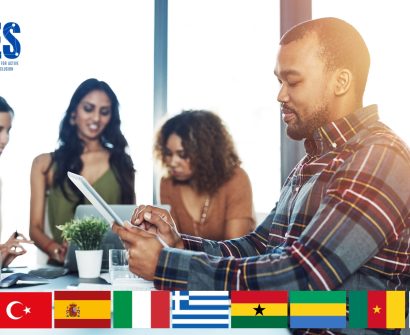
The project. The EYES Project — Empowering Youth through Erasmus+ Virtual Exchange for Active Citizenship and Social Inclusion — connects hundreds of young people and youth workers across eight countries: Spain, Italy, Greece, Türkiye, Ghana, Nigeria, Cameroon and Gabon.
The insight. Public policy has long treated economic development, education, digital transformation and civic participation as separate domains. Artificial intelligence is dissolving those boundaries — the governance of AI cannot be separated from the governance of society itself.
The takeaway. The future will belong neither to machines nor to those who fear them. It will belong to societies that can govern intelligence with wisdom, strengthen economies with inclusion, and prepare citizens to lead.
The Future Is Not Waiting
There is a familiar story about artificial intelligence. It tells us that algorithms will replace workers, machines will outperform people, and the future belongs only to those who can write code. It is a compelling narrative — but it is an incomplete one.
The future will not simply be built by artificial intelligence. It will be built by people. People who can lead, collaborate across cultures, install renewable energy systems, maintain electric vehicles, manage digital infrastructure, build sustainable enterprises, and govern intelligent technologies responsibly.
Artificial intelligence is transforming work, but it is not replacing the need for human capability. It is redefining the capabilities that matter most.
This is where the EYES Project enters the conversation.
Across Spain, Italy, Greece, Türkiye, Ghana, Nigeria, Cameroon and Gabon, hundreds of young people and youth workers are participating in one of Erasmus+’s most ambitious virtual exchange initiatives. Their discussions have gone far beyond cultural exchange — they have explored social inclusion, active citizenship, mental wellbeing, migration, sustainability, entrepreneurship, the Social and Solidarity Economy, and, increasingly, the profound implications of artificial intelligence for work and society.
These are not isolated themes. They are interconnected dimensions of one of the defining governance challenges of our generation.
The AI economy will demand more than technological innovation. It will demand institutions capable of ensuring that opportunity is distributed fairly, that technological progress strengthens rather than fragments communities, and that young people are equipped not merely to consume technology, but to shape it.
This is ultimately a question of governance. The governance of AI cannot be separated from the governance of society itself.
For decades, public policy has treated economic development, education, digital transformation and civic participation as separate domains. Artificial intelligence is rapidly dissolving those boundaries. Decisions governments make about education will determine workforce resilience. Decisions about labour markets will influence social cohesion. Choices about digital infrastructure will shape democratic participation.
This special edition is not simply a celebration of a successful Erasmus+ project. It is an examination of a larger transition.
The EYES Partnership at a Glance
COUNTRIES
CONNECTED
WORKERS ENGAGED
CONVERSATION
From Active Citizenship to the AI Economy
The EYES Project was conceived to strengthen dialogue, intercultural understanding and youth participation across Europe and Sub-Saharan Africa. Its mission remains deeply relevant.
Young people today face a world characterised by geopolitical uncertainty, climate change, technological disruption, widening inequality and unprecedented demographic shifts. Traditional education alone is no longer sufficient to prepare them for such complexity.
Active citizenship therefore becomes more than civic participation. It becomes the ability to understand systems, evaluate evidence, collaborate across cultures and contribute meaningfully to society.
Throughout the project, participants have explored issues ranging from migration and mental health to sustainable development and the Social and Solidarity Economy. More recently, these conversations have evolved naturally towards another defining question: what does meaningful work look like in the age of artificial intelligence?
This progression is neither accidental nor peripheral. It reflects the reality confronting every economy represented within the EYES partnership.
The AI Economy Needs More Than AI
One of the most persistent misconceptions surrounding artificial intelligence is that technological progress primarily rewards software engineers and data scientists. In reality, every technological revolution has increased — not decreased — the importance of practical capability.
The transition towards renewable energy requires electricians, solar technicians, battery specialists and grid engineers. The rise of electric mobility requires technicians capable of maintaining increasingly intelligent vehicles. Advanced manufacturing requires mechatronics specialists, welders and robotics technicians. Healthcare requires biomedical technicians able to work alongside AI-assisted diagnostics. Agriculture increasingly depends on precision technologies operated by skilled professionals.
Artificial intelligence is not replacing these occupations. It is transforming them.
The future workforce will therefore require something different from previous generations. Not simply academic qualifications. Not simply technical competence. But the ability to integrate practical expertise with digital literacy, critical thinking, ethical judgement and lifelong learning.
This emerging profile — the hybrid professional — represents one of the defining characteristics of the AI economy.
The Social and Solidarity Economy in an Intelligent Age
The EYES Project has consistently recognised that economies should be evaluated not only by productivity, but by their contribution to human wellbeing. This is the philosophy underpinning the Social and Solidarity Economy (SSE): cooperatives, community enterprises, social businesses, mutual organisations, youth-led initiatives.
These institutions remind us that economic value and social value are not competing objectives. They reinforce one another.
Artificial intelligence presents both opportunities and risks for this model. If governed responsibly, AI can strengthen the SSE by helping community organisations understand demand, optimise scarce resources, improve service delivery and measure social impact. If left entirely to market forces, however, AI risks concentrating economic power, widening inequalities and excluding precisely those communities the SSE seeks to empower.
Technology therefore cannot be separated from governance. The question is no longer whether AI will transform economic systems. The question is whether those systems will remain inclusive.
Technical and Vocational Education as Strategic Infrastructure
For too long, technical and vocational education (TVET) has occupied a secondary position within public discourse. The AI economy challenges that assumption.
Modern economies require skilled professionals capable of designing, installing, operating and maintaining increasingly intelligent systems. The technician who installs a solar microgrid. The mechanic diagnosing an electric vehicle using predictive analytics. The construction specialist working with digital twins. The healthcare technician maintaining AI-enabled diagnostic equipment. These professions are becoming more — not less — strategic.
Technical and vocational education should therefore be understood as critical national infrastructure. Countries capable of combining technical excellence with digital capability will possess significant economic advantages throughout the coming decades. This is particularly relevant across Europe and Africa, where demographic change, energy transition and digital transformation are creating entirely new labour-market opportunities.
Governance Before Technology
Artificial intelligence is often discussed as though it were purely an engineering challenge. It is not. It is fundamentally a governance challenge.
- Who determines how AI systems are deployed?
- Who remains accountable when automated systems influence employment, education or access to opportunity?
- How should societies ensure transparency, fairness and human oversight?
- How should young people be prepared not merely to use AI, but to question it responsibly?
These questions extend far beyond computer science. They require civic education, ethics, law, economics, public administration and international cooperation.
The governance of artificial intelligence ultimately begins with the governance of people.
Projects such as EYES demonstrate that responsible AI begins long before algorithms are deployed. It begins by developing informed, engaged and globally connected citizens capable of navigating increasingly complex technological societies.

AIESEC Alumni Ghana
Turning global vision into local impact.
Behind every successful international partnership are institutions capable of translating ambitious ideas into meaningful local action. As the implementing partner for Ghana, AIESEC Alumni Ghana has played that role throughout the EYES Project.
Working alongside European consortium partners, the organisation has facilitated participant engagement, supported youth workers, coordinated national activities and strengthened connections between Ghanaian communities and an international network committed to active citizenship and social inclusion.
Its contribution extends beyond programme delivery. It has created spaces where young people examine some of the defining questions of our time:
- How should communities respond to rapid technological change?
- How can entrepreneurship become more inclusive?
- What role should the Social and Solidarity Economy play in addressing youth unemployment?
- How can technical and vocational education prepare the next generation for intelligent industries?
- What responsibilities accompany the increasing use of artificial intelligence?
These are precisely the conversations that responsible governance requires. Through dialogue, collaboration and practical engagement, AIESEC Alumni Ghana is helping ensure that global conversations generate tangible local impact — while enabling Ghanaian youth to contribute their own perspectives to an international community of learning.
The EYES Legacy
The success of the EYES Project should not ultimately be measured by the number of workshops delivered or exchanges completed. Its lasting contribution will be measured by something far more significant: whether it produces a generation of young people capable of leading societies through one of the greatest technological transformations in human history.
A generation that understands that artificial intelligence is neither inherently liberating nor inherently threatening. That technology without inclusion widens inequality. That innovation without ethics weakens trust. That economic growth without solidarity leaves communities behind. And that governance — not technology alone — will determine whether artificial intelligence becomes a force for shared prosperity or deeper division.
The future will belong neither to machines nor to those who fear them. It will belong to societies capable of governing intelligence with wisdom, strengthening economies with inclusion, and preparing citizens to lead.
That is the promise of the EYES Project. And that is why its work matters far beyond the duration of a single Erasmus+ programme.
It speaks directly to one of the defining questions of the twenty-first century: How do we build societies that are not only AI-powered, but human-centred?
The EYES Project is implemented by a consortium of youth and civil-society organisations across Europe, Türkiye and Sub-Saharan Africa, co-funded by the Erasmus+ Programme of the European Union.

read more and subscribe at www.theaigovernancebrief.com